ChatGPT Video: AI Maker
- 0.0
- Rating
- 10.00K
- Installs
- Free
- Price

 Analysis by App-foxy
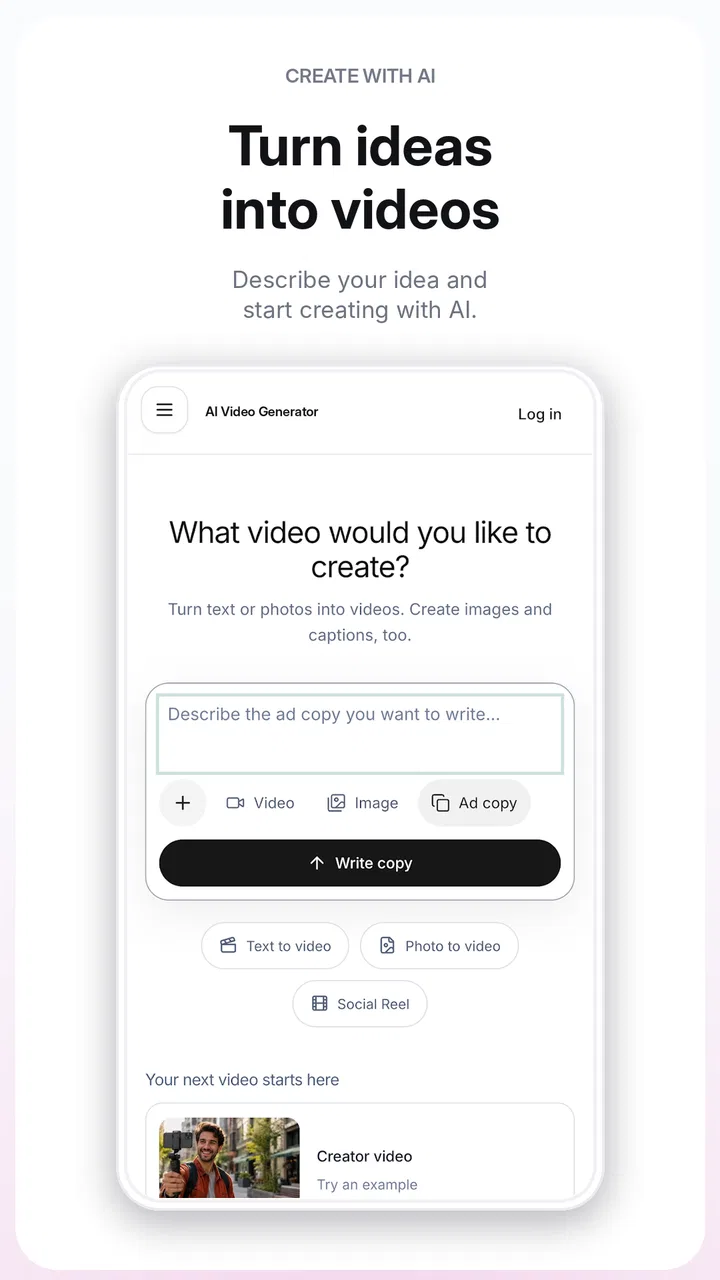
ChatGPT Video: AI Maker is the kind of social app I would open when I have an idea for a short video, post, or advertising concept but not enough time to build everything from scratch. It comes from Clawdi and is designed around AI-assisted content creation rather than ordinary social browsing. In my experience, its appeal is straightforward: I can begin with a rough request, develop the idea through conversation, and turn that direction into marketing material without jumping between several unrelated tools.
That convenience is useful, but it also changes how I judge the app. It is not simply a video editor, and I would not treat it as a complete replacement for a professional production suite. Its real value is in reducing the distance between an unfinished thought and a usable first draft. When I use it with a clear workflow, it feels practical. When I expect perfect creative decisions from a single prompt, the experience becomes much less convincing.
How I use ChatGPT Video: AI Maker from the first idea to a finished draft
I start with the purpose of the content rather than asking for a vague “good video.” For example, if I were preparing a short promotion for a neighborhood bakery, I would explain who the audience is, what the bakery wants people to do, the tone it prefers, and where the content will appear. That gives the app a useful brief to work from. The more specific the starting instruction, the less time I spend correcting an unfocused result.
You May Also Like

 AccuWeather: Weather Radar
AccuWeather Review: A Quick, Clear Forecast for Everyday Decisions
For everyday plans, the best forecast is the one you can understand quickly. AccuWeather makes rain timing, radar, and local conditions easy to act on, with a few trade-offs.

 Hill Climb Racing
Why Hill Climb Racing Still Turns Crashes Into One More Run
A tiny car, a bumpy hill and one more upgrade: Hill Climb Racing keeps resurfacing because its simple chaos makes every near-miss feel personal.

 AliExpress - Shopping App
AliExpress Makes Global Shopping Feel Personal, but Shoppers Bear the Risk
AliExpress turns a global marketplace into a pocket-sized discovery engine. Its reach is useful, its shopping loop compelling, and its trade-offs easy to miss.

 Lords Mobile: Kingdom Wars
Lords Mobile Is a Kingdom-Building Routine, Not a Quick Match
A case-by-case verdict on the building, battles, device demands, and social commitments that make Lords Mobile rewarding for some players and exhausting for others.

 PDF Scanner app - TapScanner
TapScanner Makes Paperwork Easier to Capture, Check, and Share
TapScanner makes scanning with a phone feel less like a rescue operation and more like a dependable step in getting work done. Its capture tools are useful, though not flawless.

 Block Blast!
 Shows How Much a Puzzle Game Can Leave Out
A quiet grid game shows why puzzle players increasingly value instant clarity, repeatable skill and low-pressure play—and where the genre still needs to catch up.
More From Our News Desk
View All News


My baseline workflow is to separate planning from polishing. First, I ask for a simple concept and a short structure. Then I review whether the opening makes sense, whether the main message arrives quickly, and whether the call to action fits the audience. Only after that would I ask for variations or a more polished version. This prevents a common mistake with AI tools: spending time refining an idea that was weak from the beginning.
The same approach works for posts and ad campaigns. I can use one conversation to clarify the message, then reshape it for different formats or audiences. I find this more useful than asking for several disconnected pieces of content because the central idea stays more consistent. It also makes comparison easier: I can judge whether a change improves the message or merely makes the wording sound different.
For a realistic everyday scenario, imagine that I have taken a few product photos for a small online shop during a lunch break. I could use the app to turn the product’s main benefit into a short video concept, create accompanying post copy, and sketch an ad direction before returning to work. The advantage is not that the app magically replaces the shop owner’s knowledge. The advantage is that it helps organize that knowledge into content while the idea is still fresh.
I would still check every important detail myself. Names, claims, prices, availability, and instructions should never be accepted automatically just because the wording sounds confident. For a business, a polished mistake is more damaging than an obviously unfinished draft. I treat the generated material as a working version that needs a human review before publication.
What I check before asking for another version
When a result feels weak, I do not immediately rewrite the entire request. I first identify the actual problem. Sometimes the opening is too slow; sometimes the tone is wrong; sometimes the message contains too many ideas. I then give one focused correction at a time. This creates a more predictable editing process and makes it easier to understand which instruction improved the result.
A useful habit is to keep the audience fixed while changing only the creative angle. For instance, I might request a friendly version, a more direct version, and a version that emphasizes a practical benefit. Comparing these versions side by side is more valuable than collecting many unrelated drafts. It shows which parts of the message are essential and which are just decorative language.
I also prefer short briefs over long autobiographical explanations. A compact instruction containing the audience, objective, tone, key facts, and desired action usually gives me a cleaner foundation. If I include every possible thought at once, the important point can become buried. This is one of the less obvious lessons with a conversational AI studio: better input is often more useful than more input.
Settings and choices worth checking before creating
Before I begin a serious project, I look through the available choices in the creation flow instead of rushing straight to generation. The exact controls I use depend on the task, but I pay particular attention to any option that affects the intended format, audience, tone, or campaign purpose. These choices matter because the same idea can work very differently as a social post, a short video, or an advertisement.
I also check whether my request clearly distinguishes facts from creative suggestions. If a product has a fixed feature or a specific promise, I write that information plainly and ask the app to preserve it. If I want imaginative wording, I label that as flexible. This small separation helps reduce accidental exaggeration and makes the final review quicker.
The app is free to install, which makes it easy to test without committing money at the start. However, in-app purchases are listed from $38.99 to $389.99 per item, so I would not treat the free entry point as proof that every useful workflow will remain cost-free. Anyone testing it for regular business work should inspect the purchase prompts carefully and decide whether the expected time savings justify the possible expense.
That pricing range changes my recommendation for casual users. If I only want to experiment with a few playful ideas, I would be cautious about moving beyond the basic experience. For someone producing content repeatedly, the calculation is different: the relevant question is whether the app helps complete enough real work to earn its place in the workflow. I would make that decision only after testing it on actual projects, not on an idealized example.
Compatibility is another practical point. The app requires Android 7.0 or later, so users with older Android devices should check their system before planning around it. The current version is 1.1.5, and because the product is still relatively focused on an AI-first creation experience, I would keep expectations flexible as the app develops. I would also save important drafts or source notes outside the app while working, simply because good content should not depend on one workspace alone.
Repeatable habits that make the app faster
Experienced use is less about finding a magic prompt and more about building a repeatable sequence. I keep a small brief for each project with the audience, objective, essential facts, tone, and final action. I can then reuse that structure when asking for a video idea, a matching post, or an ad variation. This reduces the mental effort of starting over and makes the outputs easier to compare.
Another effective pattern is to ask for a content package in stages. I begin with the central message, move to the visual or narrative direction, and finish with supporting copy. If I ask for everything at once, the result may look complete while hiding contradictions between the video idea and the post text. Staging the work gives me checkpoints where I can correct the strategy before polishing the language.
I find it especially helpful to request alternatives with a reason attached to each one. Instead of asking for ten random hooks, I might ask for one that emphasizes speed, one that emphasizes trust, and one that emphasizes simplicity. The output then becomes a set of strategic options rather than a pile of similar sentences. This is a practical way to use the app’s conversational nature without letting the conversation become directionless.
For recurring campaigns, I would keep a consistent naming habit in my own notes and record which version was intended for which audience. The app can help generate variations, but it cannot replace basic project organization. If I lose track of the original objective, the ability to produce more drafts becomes a disadvantage rather than a benefit.
I also avoid making the first draft too polished. A rough version exposes structural problems quickly. Once the order of ideas works, I ask for a cleaner tone and tighter wording. This two-pass method is faster than trying to make the initial request perfect, and it makes my own judgement more important than the novelty of the generated language.
Where the AI workflow reaches its limits
The biggest limitation is that AI assistance does not automatically provide taste, context, or accountability. ChatGPT Video: AI Maker can help me explore a direction, but I remain responsible for deciding whether that direction is appropriate. A campaign aimed at a sensitive audience, a regulated subject, or a reputation-critical brand needs more careful human review than a casual announcement.
I am also cautious about visual expectations. The app’s store summary presents it as a place for creating AI videos, posts, and advertising campaigns, but that does not mean every result will have the finish, continuity, or brand precision of a dedicated production team. If I need exact visual timing, detailed editing control, advanced sound work, or frame-by-frame correction, I would rather use a specialist video editor alongside an AI assistant.
The same distinction applies to social publishing. This is a social-category app, but I would not assume that content creation and audience management are the same thing. Creating a post is only one part of running a social presence. Scheduling, responding to comments, checking performance, and maintaining a consistent community voice may require other tools or manual work. I would choose this app for the creation stage, not automatically for the entire social operation.
There is also a risk of sameness. If I accept the first attractive draft, my content can end up sounding like every other AI-assisted campaign. I counter that by adding specific customer knowledge, real product details, and a point of view that the app could not know on its own. The strongest results come when I use the app to structure and accelerate my thinking, not when I ask it to invent the identity of a business from nothing.
Privacy and sensitivity deserve common sense as well. I would avoid placing confidential customer information, private business plans, or unnecessary personal details into any conversational creation tool. Even when the task seems harmless, a cleaner workflow is to provide only the information needed to produce the content. That keeps the brief focused and reduces avoidable exposure.
Who should use it, and who should choose something else
I think the app is a good fit for a solo business owner, a small marketing team, a creator testing ideas, or anyone who regularly turns rough notes into social content. It is particularly useful when the bottleneck is not filming or editing but deciding what to say and how to adapt one idea across several forms. The conversational approach can make that early planning stage feel less intimidating.
It may also suit a beginner who does not yet have a reliable content process. By moving from a brief to a concept and then to variations, the app can encourage more deliberate planning. I would still recommend learning basic communication principles alongside it, because understanding the audience remains more valuable than knowing how to phrase a clever request.
I would skip it if I need a full professional editing environment, precise production controls, or a complete publishing and analytics system in one place. A dedicated video editor is the better choice for detailed post-production. A conventional social management platform is more appropriate when scheduling, inbox work, and performance tracking are the central tasks. ChatGPT Video: AI Maker is strongest before and around production, not necessarily after every other part of marketing has been added.
The age rating is Everyone, which makes the app broadly approachable from a content-rating perspective. That does not remove the need for adult judgement when it is used for commercial work, public claims, or material intended for children. The rating describes general suitability; it does not validate every idea a user may create with an AI tool.
My verdict after treating it as a working studio
After using it as a structured assistant rather than a one-tap content machine, I see a useful product for fast ideation and early campaign development. Its best quality is the way it can connect a rough thought to several related content directions. I can begin with a simple objective and gradually turn it into a video concept, post language, and advertising angle while keeping the conversation focused.
The app’s weaknesses are just as important. The quality depends heavily on the brief, the user still has to verify every meaningful claim, and the experience should not be confused with a complete professional production system. The in-app purchase range also means that regular users should evaluate the cost carefully rather than assuming the free installation tells the whole story.
Clawdi’s app has reached over ten thousand installs, and its Everyone rating makes it approachable for a wide audience. I would describe it as a practical starting point for people who need momentum, not as a final authority on creative or marketing decisions. That distinction is central to getting good results.
My recommendation is simple: use it to shorten the distance between an idea and a well-organized draft, then bring your own judgement to the final work. If that is the part of content creation slowing you down, this free social app is worth exploring. If your priority is exact editing, deep campaign measurement, or hands-off publishing, I would pair it with more specialized tools instead of expecting one AI studio to handle everything.
FAQs for ChatGPT Video: AI Maker
01What is ChatGPT Video: AI Maker and what can it do?
ChatGPT Video: AI Maker is an AI-powered mobile app designed to help users create short videos from written prompts, ideas, or other provided content. Depending on the available tools, it may assist with scripts, scenes, captions, visual elements, voiceovers, or basic editing. It is best suited to social media clips, promotional concepts, educational content, and quick creative experiments rather than full professional film production.
02Is ChatGPT Video: AI Maker free to download and use?
The app may be available to download at no initial cost, but some features can be restricted behind in-app purchases, subscriptions, credits, or usage limits. Before creating multiple videos, check the current pricing page and subscription terms shown in the App Store or Google Play listing. Also review whether trials automatically renew, since cancellation usually must be completed through your device’s account settings.
03Do I need an internet connection to create videos with the app?
Yes, an active internet connection is generally required because AI video generation is processed through online servers rather than entirely on your phone. A stable Wi-Fi or mobile-data connection can make generation more reliable, especially when uploading images, producing longer clips, or downloading finished projects. Weak connections may cause failed generations, delays, or additional data consumption.
04Can ChatGPT Video: AI Maker create videos suitable for professional or commercial use?
The app can be useful for producing social posts, drafts, advertisements, presentations, and other lightweight commercial material, but the final quality depends on the prompt, selected tools, and subscription plan. Before using generated content commercially, carefully check the app’s license, ownership, watermark, music, image, voice, and model terms. You should also verify facts and obtain permission for recognizable people, brands, or copyrighted material.
05Is the content generated by ChatGPT Video: AI Maker always accurate and safe to publish?
No AI-generated video should be published without review. The app may produce incorrect information, unnatural narration, visual glitches, unsuitable wording, or images that do not match the prompt. Read every script, inspect each scene, and listen to the audio before sharing the result. Avoid entering confidential personal or business information, and confirm how the developer stores and handles prompts and uploaded files.
Pros
- Turns text prompts into short AI-generated videos quickly.
- Offers creative templates for social media content.
- Simple interface suitable for beginners.
- Can help visualize ideas without advanced editing skills.
- Useful for creating promotional or educational clips.
Cons
- Video quality may vary depending on the prompt and chosen style.
- Advanced exports or features may require a paid plan.
- Generation times can increase during busy periods.
- AI results may include visual mistakes or inconsistent details.
- Requires an internet connection for most generation tools.

ChatGPT Video: AI Maker
Gallery